
AI Visibility Case Study: How AI SEO (GEO) Increased AI Crawler Traffic from 400 to 5,700 Hits in Luxembourg

Why AI Visibility(GEO) Matters Now
While traditional search engines like Google still dominate web discovery, a new layer of information access is emerging: AI-powered answer engines.
Platforms such as OpenAI (used in ChatGPT) and Perplexity AI are increasingly used by people to ask questions and receive direct answers instead of browsing search results.
For businesses and websites, this creates a new challenge:
How do you ensure your content is visible to AI systems that generate answers?
This discipline is increasingly referred to as AI Visibility — the process of optimizing websites so that AI models can discover, understand, and reference their content when answering user questions.
In this case study, we’ll show how implementing an AI visibility strategy led to a significant increase in AI crawler traffic over just nine months.
The Starting Point: April 2025
In April 2025, we began actively optimizing a website for AI visibility.
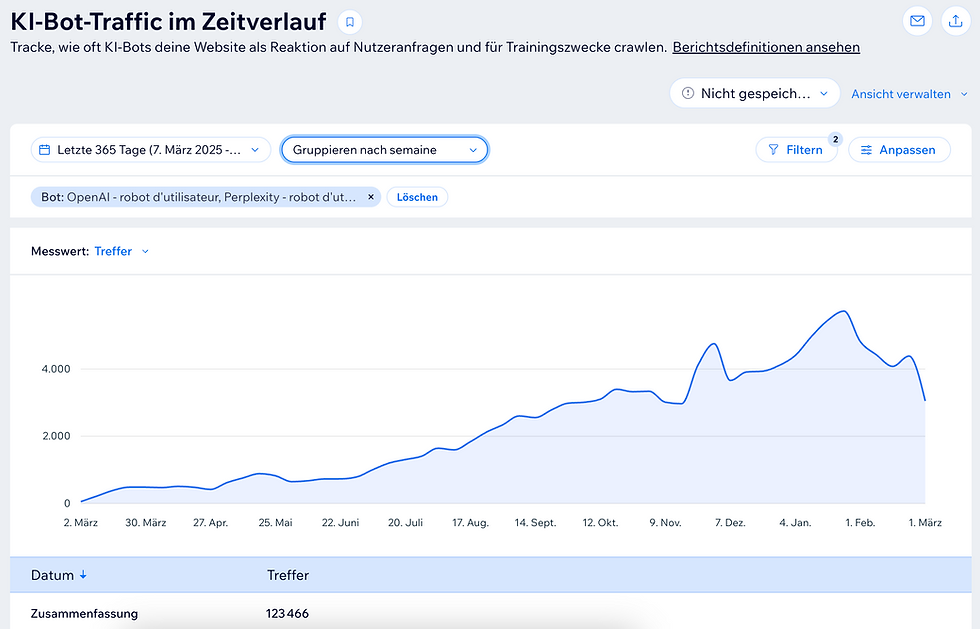
At that time, the site received around 400 weekly hits from AI crawlers.
These requests were coming specifically from:
OpenAI’s user-answer crawlers
Perplexity AI’s answer retrieval systems
It’s important to note that these numbers do not include traditional search engine bots such as Google or Microsoft.
The traffic shown here only reflects AI systems retrieving website content to generate answers for users.
The Result: 14× Growth in AI Crawler Activity
By January 2026, the number of AI crawler hits had grown dramatically.
April 2025: ~400 weekly hits
January 2026: peak of 5,700 weekly hits
That represents an increase of more than 14 times the original level of AI crawler activity.
This growth indicates that the website became significantly more visible and relevant to AI answer systems, meaning its content was increasingly being accessed as part of AI-generated responses.
What Is AI Visibility?
AI visibility refers to the ability of a website to be discovered, processed, and referenced by AI systems when generating answers to user questions.
Unlike traditional SEO, which focuses on ranking in search results, AI visibility focuses on being used as a knowledge source for AI-generated responses.
AI models evaluate and retrieve information differently from search engines. Instead of ranking pages primarily based on backlinks and keyword signals, AI systems focus heavily on:
clarity of information
contextual relevance
topical authority
structured content
factual density
This means that websites optimized for AI visibility often look slightly different from traditional SEO-focused sites.
The Strategy Behind the AI SEO(GEO) Growth
The increase in AI crawler traffic was the result of a deliberate AI visibility optimization strategy implemented starting in April 2025.
The strategy focused on four key areas.
1. Structured, Semantic Content
AI models interpret information more effectively when content is clearly structured and logically organized.
We focused on creating content that is easy for AI systems to understand and extract information from.
Key improvements included:
clear heading structures
question-and-answer formatting
well-defined topic sections
semantically organized paragraphs
This makes it easier for AI systems to identify specific information relevant to user queries.
2. Topical Authority Through Content Clusters
AI systems are more likely to trust and reference websites that demonstrate deep expertise in a specific topic area.
Instead of publishing isolated articles, we built topic clusters that cover subjects comprehensively. This approach helps AI models understand that the website is a reliable knowledge source on the topic. Over time, this significantly increases the probability that AI systems will retrieve and cite information from the site.
3. Technical Accessibility for AI Crawlers
AI crawlers behave differently from traditional search engine bots. To ensure smooth crawling and indexing, we optimized the site’s technical structure to make it easily accessible to AI systems.
Key improvements included:
logical internal linking
clear page hierarchy
improved crawl accessibility
This ensures that AI bots can efficiently navigate and retrieve relevant information.
4. High Information Density
AI systems prefer pages that contain substantial informational value. Rather than publishing many short or shallow articles, we focused on creating deep, comprehensive pages that answer multiple related questions within a single topic. This increases the likelihood that AI systems will extract answers from those pages.
Why AI Crawler Traffic Matters
AI crawler traffic is a strong indicator that your website is being used as a source of information for AI-generated answers.
When AI systems retrieve your content, they may:
use it to generate answers
summarize it in AI responses
cite the website as a source
rely on it to improve model knowledge retrieval
As AI assistants become more widely used, this type of visibility will become increasingly valuable.
The Shift from Search to Answers
For decades, the internet has been built around search results pages. Users would type a query, browse several links, and choose the best result.
AI systems are changing this behavior.
Instead of browsing multiple links, users increasingly receive a single synthesized answer generated by AI. This shift fundamentally changes how information is discovered online.
The key question for websites is no longer just:
“How do we rank in search results?”
It is increasingly becoming:
“How do we become a trusted source for AI-generated answers?”
What Businesses Should Do Now
Many companies have not yet started thinking about AI visibility. However, as AI assistants become more integrated into everyday search behavior, early adopters will gain a significant advantage.
Organizations that optimize their websites now will benefit from:
stronger AI discoverability
earlier inclusion in AI knowledge systems
higher probability of being cited in AI answers
In other words, AI visibility is becoming the next evolution of SEO.
Key Takeaways
The case study above shows that AI visibility optimization can have a measurable impact.
By implementing a structured AI visibility strategy in April 2025, we increased AI crawler traffic from 400 weekly hits to a peak of 5,700 hits by January 2026.
And importantly, this growth reflects activity from AI answer systems only, specifically OpenAI and Perplexity.
As AI-powered discovery continues to grow, businesses that invest in AI visibility today will be better positioned to be seen, understood, and referenced by AI systems tomorrow.


Comments